
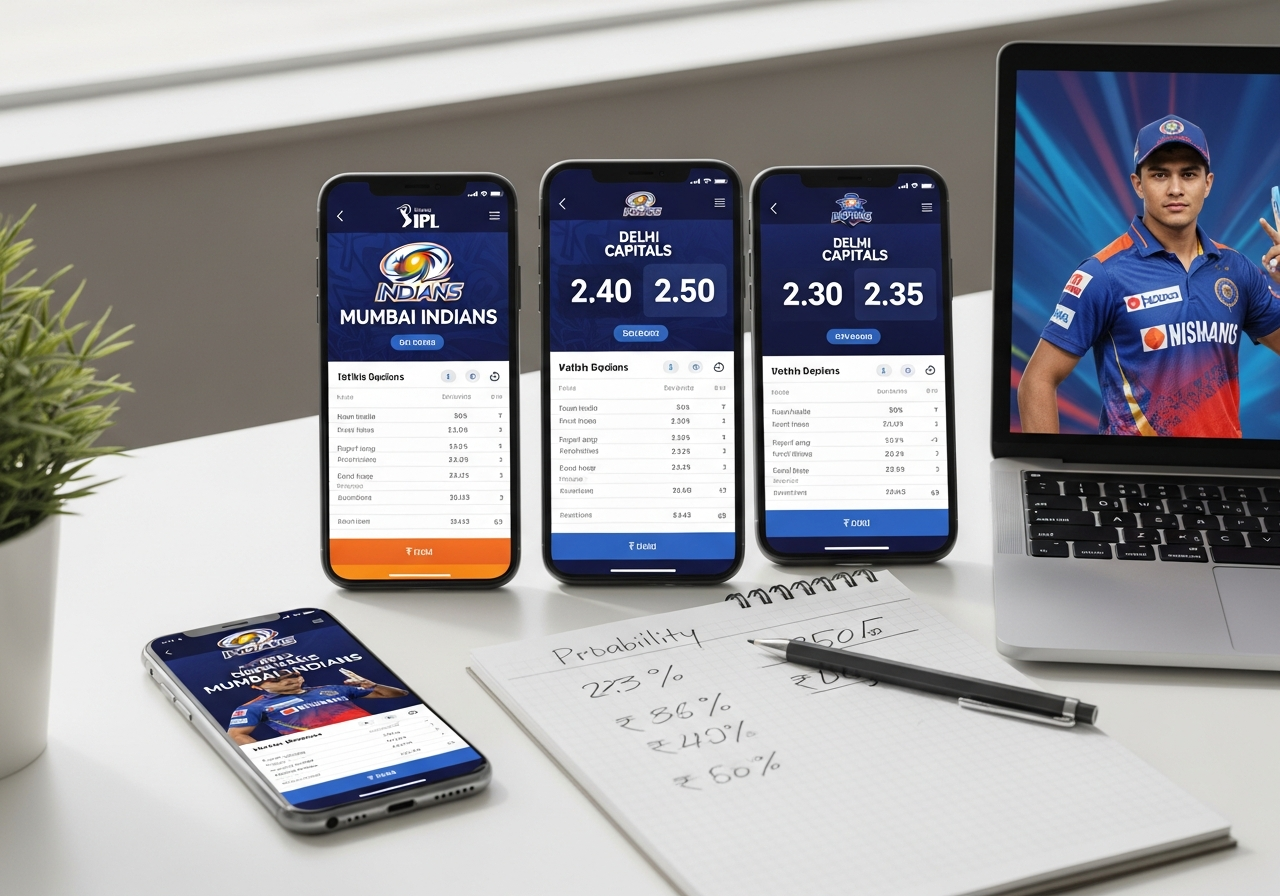
When you’re betting on IPL matches, you’ve probably noticed something frustrating: the same team at different bookmakers shows completely different odds. That’s not a coincidence. Thousands of Indian bettors leave significant value on the table every season by accepting the first odds they see rather than hunting for the best price. Whether you’re interested in match winners, player performance props, or in-play markets, the difference between a 2.40 price and a 2.50 price compounds heavily over time and directly affects your long-term profit. This guide teaches you how to systematically find and lock in the best cricket betting odds—pre-match and live—across Indian and global bookmakers, using structured comparison workflows and proven value-hunting techniques that work within India’s unique betting landscape.
Understanding IPL Cricket Betting Odds For Indian Bettors
Odds aren’t just predictions; they’re prices. When a bookmaker sets Mumbai Indians at 1.95 to win an IPL match, they’re saying: “If you stake ₹100 at these odds, you’ll get ₹195 back if they win.” The odds reflect what the bookmaker believes is the probability of that outcome, adjusted for their margin. Bookmakers set IPL prices using specialist traders who analyse team form, head-to-head records, venue conditions, pitch type, weather, and injury news. Every time new information surfaces—a key player gets ruled out, the pitch looks drier than expected, or early betting action suggests smart money on one side—the odds shift in real time. Understanding how and why prices move is the foundation of finding better odds than you otherwise would.
The crucial distinction is between odds and actual probability. Implied probability is the bookmaker’s embedded belief about what will happen. If a price is 2.50 in decimal format (common for Indian bettors), the implied probability is 1 ÷ 2.50 = 0.40, or 40%. If you think that outcome is actually more likely—say 45%—then this odd offers value. Your job is to spot when the bookmaker’s price is out of line with reality. Decimal odds dominate Indian betting platforms, making comparison straightforward. You may occasionally encounter fractional odds (used on UK-facing sites for IPL, such as 3/2) or American odds (on international sportsbooks), but decimal remains the standard. The rest of this guide teaches you how to use this framework to consistently find better-than-average prices rather than simply backing favourites or chasing the biggest numbers.
How IPL Odds Are Calculated And Why They Move
Specialist traders at major sportsbooks adjust IPL prices in real time, using live data feeds, statistical models, and market feedback. When an injury is announced, when the toss outcome is revealed, or when sharp informed bettors suddenly place large stakes on one side, the odds ripple within seconds. Key drivers of line movement include team news and injuries, toss results, updated pitch and weather information, early injury or tactical news, sharp action from professional bettors, and in-play events like early wickets or a runaway start.
Odds are dynamic signals. If the line moves significantly between your shortlist and match time, it often signals that the market has discovered something you missed—or that sharp money has arrived. Learning to read these signals helps you identify when odds drift into value territory. For example, if a favourite’s odds drift from 1.80 to 2.10 because a key batter is ruled out minutes before the match, you might see opportunity if the underlying matchup still favours them. Conversely, if an underdog’s price shortens from 3.50 to 2.80 without obvious news, it can mean informed bettors are confident. Tracking why prices move trains your eye to spot genuine value.
Odds Formats Used For IPL: Decimal, Fractional & American
Decimal odds are the standard for Indian bettors and most global platforms serving India. A price of 2.50 means that a ₹100 stake returns ₹250 (including your stake). Fractional odds, common on UK-facing sites and sometimes shown for IPL, appear as 3/2, meaning you win ₹3 for every ₹2 staked (so a ₹100 stake returns ₹250 total). American odds (or moneyline odds) appear as +150 or -150, common on US-based sportsbooks; these are less relevant for Indian bettors but occasionally appear on international platforms offering IPL markets.
Rather than memorising conversion formulas, focus on understanding payouts and implied probability. A price of 2.50 (decimal) is equivalent to 3/2 (fractional) and +150 (American), all implying a 40% chance. When comparing odds across sites, always ensure you’re looking at the same format or convert to decimal as your standard. Most platforms serving Indian users display decimal odds by default, making cross-checking straightforward. The key takeaway: master decimal odds for your main comparisons, and don’t let unfamiliar formats deter you from checking international sites for occasional better prices on niche markets.
Converting IPL Odds To Implied Probability And Value
| Odds Format Example | Implied Probability | What It Means For IPL Bettors | When It Might Offer Value |
|---|---|---|---|
| 1.50 (Mumbai Indians favourite) | 66.7% | Bookmaker believes the favourite has a 2 in 3 chance; public bias often keeps favourites overpriced | If your analysis suggests 70%+ probability, value is marginal; wait for better entries |
| 2.50 (Balanced match-up) | 40% | Slight underdog at even-money conditions; common for second-favourite outcomes | If you assess 45%+ probability, this offers a 5% value edge over the season |
| 3.50 (Underdog, high variance) | 28.6% | Significant underdog; pricing reflects long odds but can hide value if team is stronger than perceived | If a team’s form, pitch, or head-to-head suggests 35%+ chance, value is clear |
| 5.00 (Heavy underdog or rare outcome) | 20% | Extreme long shot; used for upset bets or niche player props; sharp value hunting ground | If conditions favour the underdog heavily (new opening partner, spin-heavy pitch) and you assess 25%+ chance, chase it |
Implied probability is the foundation of hunting for the best odds. The formula is simple: Implied Probability = 1 ÷ Decimal Odds. A price of 2.50 implies 40%; a price of 1.50 implies 66.7%. When comparing odds across bookmakers, always convert to implied probability first, then ask yourself: Does this price match what I believe is truly likely? If your research suggests a team has a 45% chance of winning but the market shows 40%, that bet offers value—not because you’re confident of winning that particular match, but because over time, you’re betting at better-than-fair prices.
The table above shows typical IPL prices and what they tell you. A favourite at 1.50 implies a 66.7% chance; public bias and safer margins often keep favourites slightly overpriced relative to their true win rate. Balanced match-ups at 2.50 (40% implied) often hide value for thorough analysts. Underdogs at 3.50+ are less efficient markets, meaning sharper bettors have sometimes already extracted value, but they’re also where casual bettors underrate team strength or pitch advantage. Value betting means your estimated probability consistently exceeds the implied probability. This isn’t about winning every bet; it’s about consistently getting odds that offer a long-term edge.
Quick Methods To Spot Mispriced IPL Odds
Before you even open an odds comparison tool, use a mental checklist to flag when prices look out of line. Compare recent form (last 5 matches), head-to-head records (especially at the same venue), ground conditions (batting-friendly vs bowling-friendly pitches), and weather forecast. If a team is in hot form but priced as a heavy underdog without fresh injury news, that’s a flag. If two evenly-matched sides are priced at 1.80 vs 2.10 without obvious advantage, check whether the market is overweighting a star batter or bowler.
Popular teams and star players attract casual betting money, which can inflate their odds artificially. A Mumbai Indians or Virat Kohli bet may be overpriced simply because millions of casual fans are backing them, not because the underlying matchup favours them. Conversely, less glamorous outcomes—like a struggling opener to score most runs in a specific powerplay, or a second-string bowler to take the most wickets—often carry softer odds because fewer bettors research them. Track a few teams across multiple matches to build intuition for what “fair” pricing looks like in your preferred markets. Over time, you’ll spot when the market strays too far from fundamentals.
Comparing IPL Odds Across Different Betting Sites
- Shortlist 3–5 Indian-friendly sportsbooks with strong IPL markets, secure UPI/local payment methods, and reputation for fair odds. Having multiple accounts is the single most powerful way to find better prices; it takes 10 minutes per match but pays dividends across a season.
- Open the same IPL market simultaneously across your chosen sites. For a match winner bet on the primary fixture, load that outcome on all five sites in separate browser tabs or your phone apps to see live prices side by side.
- Record the exact decimal odds for your chosen outcome (e.g., Delhi Capitals to win, at 2.40 on Site A, 2.35 on Site B, 2.50 on Site C). Do this 30 minutes before the match and again 5 minutes before, to track movement and identify which site is sharpest (moves first) vs which is slower (may offer late value).
- Compare implied probabilities across all options. If your analysis suggests Delhi Capitals have a 42% chance and Site C shows 2.50 (40% implied), that’s your best value. Don’t just pick the highest number; make sure it aligns with your actual belief.
- Check for boosts, promotions, or cashback that change effective odds. A 2.50 price with a 10% boost becomes 2.75 effective odds. Verify these promos apply to your chosen market and aren’t restricted to favourites or other conditions.
- Stake at the site with the best combination of base odds, available promos, and reliability. If two sites show nearly identical odds, choose the one with faster live betting or better customer service for your region.
- Log the odds you accept and the odds at match end (closing line) to track whether you’re consistently beating the market. Over a season, positive closing line value is a powerful indicator of good decision-making.
Choosing Indian‑Friendly Sites With Strong IPL Odds
| Factor | Why It Matters For IPL Odds | What To Look For In India |
|---|---|---|
| Licensing & Safety | A licensed operator with transparent ownership reduces fraud risk and ensures odds aren’t manipulated; trustworthy pricing attracts sharp bettors, making lines more efficient | Look for clear regulatory information (e.g., Curacao, Malta, or similar); avoid unverified or suspicious sites |
| Competitive Match-Winner Odds | The headline market; sharper sites often price these tighter (lower margins), offering 1–2% better value on favourites | Check if a site prices the same match winner at noticeably better decimals than competitors; consistency across 5+ matches = a sharp book |
| Live Betting Platform | Real-time odds updates, fast bet placement, and low latency during T20 action let you catch in-play mispricing before others | Test the app/site during a live IPL match; slow platforms miss early-innings value as wickets fall |
| Cash Out Feature | Allows you to exit early at a guaranteed price, locking profit or limiting loss; critical for in-play strategies and managing variance | Verify cash out is available on your chosen markets; some sites restrict it to match winner only |
| UPI / Local Payment | Indian bettors need quick, fee-free deposits and withdrawals; Paytm, Google Pay, PhonePe, and UPI make funding effortless | Confirm the site accepts your preferred payment method; avoid sites with slow or expensive payouts |
| Hindi/Local Language Support | A site with local language tools and live chat in regional languages reduces friction and speeds odds comparison | If you’re more comfortable in Hindi or regional languages, test the site’s UI and support in that language first |
| App Stability & Speed | IPL matches move fast; a slow or buggy app costs you opportunities. A responsive native app beats a mobile web version for live betting | Download the app and test it during a live match; if it crashes or lags, move to a faster alternative |
Each factor directly impacts your ability to find and execute on the best odds. A faster live platform helps you spot in-play value before prices adjust. A site with deeper markets (not just match winner, but team totals, player props, phase runs) gives you more chances to find softer lines. Payment reliability matters because missing a deposit due to a pending transfer costs you access to that site’s odds when they’re sharp. Use this table to audit 3–5 candidate sites before the IPL season starts.
Using Odds Comparison Tools And Line Trackers For IPL
Dedicated odds comparison tools aggregate real-time prices from multiple bookmakers, letting you see at a glance which site is offering the best price for a given IPL market. Sites like Cricket Exchange, BetFair’s exchange model, and some standalone comparison apps focus on live odds feeds. Open the tool on mobile or desktop, filter to IPL, and monitor pre-match movement. If a match is priced at 2.40 on one site and 2.35 on another, the tool immediately shows the 2.40 option as better.
For in-play betting, a live odds tracker is invaluable. As runs flow and wickets fall, odds shift rapidly. A tool that updates every 10–30 seconds lets you spot when a particular outcome becomes underpriced. For example, if a batting side is 50/2 after 6 overs and their match-winner odds drift from 2.20 to 2.40 (possibly due to early loss or sharp action on the bowling side), a quick comparison tool alerts you to the mispriced move. However, always verify prices directly on the bookmaker’s app or site before confirming a bet; tools lag slightly, and promos or boosts may not be captured in real-time feeds.
Reading IPL Markets: From Match Winner To Player Specials
| IPL Market Type | Description | Key Odds Drivers | When To Target Best Odds |
|---|---|---|---|
| Match Winner | Who wins the game in 20 overs (or Super Over if tied) | Team form, head-to-head, venue, toss, injury news | Before toss; odds tighten as smart money bets |
| Outright Winner (Tournament) | Which team wins the entire IPL season | Win probability, remaining fixture difficulty, injury trends | Early season, when long-odds underdogs are mispriced |
| Top Batsman | Which batter scores most runs in the match | Opening pair, form, opposition bowlers, pitch | After toss (batting order confirmed); avoid overpricing of stars |
| Top Bowler | Which bowler takes most wickets in the match | Bowling role (pacer vs spinner), ground length, pitch | Before match; often softly priced vs match winner odds |
| Team Total Runs | Over/under a specified total (e.g., 165.5) | Pitch type, bowling attack, powerplay pace, weather | Pre-match; in-play lines move dramatically with early runs |
| Match Wickets | Over/under total wickets (e.g., 15.5) | Pitch conditions, bowling strength, batting skill mismatch | Early innings; wickets loss doesn’t always correlate to price movement correctly |
| Sixes/Fours | Total count in the match or specific innings | Boundary length, batter aggression, pace bowling pace | Live, as hitting patterns emerge; bettors often lag on data |
| Toss Winner | Coin flip; no skill edge | Coin physics (if any); often mispriced if you believe toss has edge | Avoid; nearly always fair or slightly worse odds; no persistent edge |
| Player Runs | A specific batter to score 30+ (or alternate thresholds) | Role, form, opposition bowler skills, pitch | Pre-match; allows targeted high-value plays on mis-priced performers |
| Powerplay Runs | Team runs in first 6 overs (or similar phase) | Batting aggression, opening bowling quality | Live, as early overs unfold; sharp adjustment but pockets of value |
Different markets offer distinct value opportunities. Match winner is the most liquid, attracting casual and sharp bettors alike, so pricing tends to be tight (fair). Top batsman and top bowler are softer because fewer bettors research role/opposition matchups thoroughly. Team total runs and wicket markets often hide value on alternate lines; for instance, if the main total is 165.5 runs, some sites may offer “team runs 160–170” at generous odds. Player performance markets (a specific batter to score 25+ runs) are where niche knowledge—like a change in opening position—can create edges. In-play sixes and fours markets are volatile and less efficient, offering sharp bettors quick value plays before the broader market adjusts.
High‑Value IPL Markets Most Bettors Ignore
- Player performance totals (e.g., Hardik Pandya 30+ runs, Jasprit Bumrah 2+ wickets): These are easier to forecast than match winner if you track role changes and form. A batter moving to open might be underpriced in a “20+ runs” market.
- Alternate run lines and phase-specific totals (e.g., team runs 160–170, powerplay runs 45+): Bettors anchor to the main line (165.5); alternate buckets often carry softer odds. If you believe a team scores 150–160, the “160–170” bucket at 2.50 is likely underpriced.
- Team total runs (as opposed to match winner): Venue and pitch data show strong tendencies (e.g., Delhi pitches favour high-scoring chases). Pricing a team total line with no edge, when you’ve identified a 5% bias, is value.
- Bowler-specific wickets and economy (e.g., Rashid Khan under 1.5 wickets, or Bumrah economy under 7.5 per over): Less public demand + clearer role advantage = softer lines. If Bumrah is playing against a weak batting unit, his 2+ wickets odds at 2.20 may underestimate his odds of taking 3.
- Sixes/fours alternates and boundaries in specific phases: Boundary counts are noisier (less predictable) than runs, so bettors underprice them. A match with 12–15 sixes total seems high, but on a short ground with aggressive batters, may be 40%+ likely.
- Toss-dependent angle plays: While toss itself has no edge, toss-dependent markets (e.g., “team wins if toss wins and bats first”) can be mispriced if the market hasn’t factored in the conditional probability correctly.
Experiment with one or two niche markets over 5–10 matches. Track your closing line value; if you’re consistently beating lines in player props or team totals, you’ve found a personal edge. Avoid chasing novelty; niche markets are valuable only if your analysis is sharper than the broader market.
Using Data, Stats And Match Context To Beat IPL Odds
- Team form and momentum (last 5 matches, win/loss streaks, run rates): A team on a 3-match winning streak with strong net run rate is often underpriced as an underdog if the market has over-rotated on a single loss.
- Injury and key player absence: A leading scorer ruled out changes fair odds by 5–10%. The market may take 30+ minutes to fully adjust. Early capture of this news = early value.
- Head-to-head record and venue-specific performance: If Team A has won 6 of last 8 at a specific ground, but their odds don’t reflect this (e.g., 2.50 instead of 2.00), that’s a red flag that the market is ignoring the pattern.
- Pitch and weather conditions (pitch report, toss influence, expected temperatures): A damp pitch favours swing bowling; a dry pitch favours spinners. If the pitch report suggests spin dominance but the site’s odds on a spin-heavy bowler remain unchanged, that’s value.
- Toss impact and likely batting/bowling line-ups: Knowing the likely XI before match time (team announcements, news reports) helps you assess whether the IPL odds reflect the actual batting order or an assumed order.
- Opposition quality and specific matchups (how does the opening pair fare against swing? Does the middle order struggle vs left-arm spinners?): Matchup research is often ignored in casual betting, creating pockets of edge.
- Role clarity and power-play vs death bowling assignment: A bowler used primarily at death will have different wicket probability than one used in powerplay. Odds that don’t account for this role distinction offer value.
Case Study: How A Single Factor Can Shift IPL Odds
Suppose Delhi Capitals are priced at 2.40 to beat Rajasthan Royals. Your pre-match form check shows DC in good shape. But then, 20 minutes before the match, news breaks that Delhi’s opening batter (who’s scored 300+ runs this season) is ruled out with a minor injury. The market reacts slowly; his absence reduces Delhi’s win probability by 4–6% (your estimate: from 42% to 36–38%). Within an hour, Delhi’s odds fall from 2.40 to 2.20. If you caught this news and the mispriced odds at 2.40 before the adjustment, you’ve locked in value. The batter’s absence is quantifiable; the market’s slow response creates a window.
Conversely, a surprise pitch announcement (e.g., “the Arun Jaitley pitch is expected to be spin-heavy”) might favour Rajasthan, who have more experienced leg-spinner coverage. If Rajasthan’s odds remain at 1.85 despite this advantage, that’s likely mispricing. Bettors who check pitch reports before market-wide adjustment can capture this edge. The habit of checking up-to-date team news, injury lists, and pitch/venue reports 30–60 minutes before the match—and comparing fresh odds across sites—is where consistent value emerges.
Common Analysis Mistakes That Lead To Bad Odds Choices
Overrating star names regardless of conditions is a frequent error. Virat Kohli is exceptional, but if he’s facing a world-class death bowler on a pitch favouring fast bowling, and he’s priced at 1.50 to score 40+ runs, the market may be right. Conversely, a lesser-known batter in the same scenario, facing a spin-heavy attack on a turning pitch, might be underpriced at 2.20 to score 30+. Ratings matter; conditions matter more.
Ignoring small sample sizes distorts analysis. A batter has faced a bowler twice, with scores of 50 and 8. Bettors fixate on the high score and overestimate their matchup advantage. Three matches is rarely enough to declare a trend; look for patterns across 10+ matches.
Chasing narrative-only angles without value is another trap. “This team is underdog, so they’ll bounce back” is a common story that doesn’t hold statistical weight. Back underdogs only if your analysis suggests their true probability is higher than the odds imply—not because they’re “due.”
Finally, focusing only on outcomes (match winner) instead of underlying metrics causes you to miss softer markets. A match-winner line at 1.75 for the favourite might be tight, but that team’s total runs at 156.5 (when your analysis suggests 165+) offers better value. Learn to move between markets and hunt for the best price relative to your edge.
Finding The Best IPL Odds For Live & In‑Play Betting
| In‑Play Situation | Typical Odds Movement | How To React | Risk Level |
|---|---|---|---|
| Early wicket (10/1 or 15/2 after 3 overs) | Underdog odds lengthen (e.g., 2.50 → 3.50 for underdog); favourite odds shorten (1.80 → 1.40) | Wait 2–3 overs; if early collapse was a fluke, odds may correct; only bet if you have a strong edge | High; initial panic can overprice the out-of-form team |
| Rapid start (20+ runs in powerplay) | Batting side’s odds shorten (e.g., 2.10 → 1.70); bowling side’s odds lengthen (1.75 → 2.40+) | If the start is unsustainable (e.g., 2 sixes off poor bowling), the corrective odds may not reflect this; value often lies on the bowling side | Medium-High; wait for evidence the start is real trend vs anomaly |
| Run rate acceleration (9+ runs per over) | Match totals shift upward; over/under totals recalibrate (e.g., 165.5 → 175.5); odds on batting side win shorten | Monitor if the acceleration is due to skill (aggressive intent, weak bowling) or luck (edges, dropped chances). True skill = chase the favourite; luck = potential value on underdog | High; market often over-corrects to high run rates |
| Mid-innings collapse (5 runs from 3 overs) | Batting side’s odds lengthen sharply (1.60 → 2.20+); team total lines shift lower | The collapse may be temporary; if your form/talent assessment says the team is better, value emerges as odds drift. Don’t chase panic | Medium; wait for stabilization before committing |
| Injury to key player (during match) | Odds shift in real time, but the adjustment depends on the role and severity | If a death bowler goes down and the side has poor death bowling backup, favourites odds may not shorten enough (value for underdog). If an opener gets hurt but team has solid #3, the shift is smaller | High; assess team depth immediately |
| 10-over point (milestone) | Odds for final target, chase margin, and winner recalibrate based on 10-over run rate | This is where sharp bettors often strike; markets are dynamic here. Compare live odds across sites; differences are widest | Medium; fast decision-making required |
Live IPL satta rates (as they’re known colloquially in India) change ball by ball. A wicket in the first over can shift a favourite’s odds by 0.20–0.50 in decimal terms. The speed of adjustment depends on the bookmaker’s trader and the liquidity of the market. Larger, sharper books adjust within seconds; slower books lag by 30–60 seconds. This latency is where disciplined bettors find in-play value—not by reacting faster than everyone, but by making better judgments about whether the odds have over-corrected or under-corrected to new information.
The key to in-play success is recognizing that a single wicket or boundary doesn’t immediately change true win probability proportionally. An early wicket in a T20 is noisy (high variance); teams bounce back regularly. If a team collapses to 20/3 and their odds move from 1.80 to 3.50, the market has likely panicked. Your job is to stay calm and ask: “Given this team’s remaining batting depth and the opposition bowling, is 3.50 value?” Often, yes—but only if you’ve pre-researched the batting order.
Live Odds Tactics: Multi‑Bookie Set‑ups For IPL
- Before match start, open the match-winner odds on 3–5 chosen sites in separate browser tabs or apps. Position them side by side on a large screen (or use phone split-screen if mobile). Set a reminder to refresh every 30 seconds during the powerplay and every 2 minutes during mid-innings.
- During the first 10 overs (powerplay), track how odds move across sites. If a wicket falls, note which site adjusts first and how much. Faster sites are sharper and will offer fewer edges; slower sites lag and create value windows.
- When a significant in-play event occurs (early wicket, quick boundary, bowling change, rare skill display), immediately compare odds across all open sites. If one site is still showing old odds (e.g., 2.40) while another has moved to 2.60, the slower site is offering value.
- Stake only when a standout price appears relative to your judgment. If you believe the batting side has a 45% true chance and you see 2.50 (40% implied) on one site but 2.30 (43.5%) on another, the 2.50 is worth considering only if you expect further odds drift before match end.
- Use cash out strategically. If you backed the batting side at 2.40 in-play and they score 60/1 after 8 overs (strengthening their odds), a cash out at 1.60 may lock profit or reduce loss. Compare the cash-out price to your belief in their final outcome.
- After the match, log the odds you accepted vs the closing odds. Over 10+ in-play bets, this log reveals whether you’re catching mispricing or chasing momentum.
Leveraging Offers, Boosts And Cash Out To Improve Effective Odds
- Odds boosts and profit boosts (e.g., “Back Delhi Capitals at +20% boost”): A 2.50 price boosted by 20% becomes 3.00. Use boosts only on outcomes where your independent analysis suggests value; don’t boost a bad bet into a good one.
- Early payout and advanced settlement (e.g., “get paid if your team goes 1-0 up”): Some IPL promos pay out partial returns if a condition is met before the match ends. Evaluate whether the early payout odds offer better expected value than holding to the finish.
- Cashback and loss-back promos (e.g., “10% cashback on your first 5 bets”): Cashback effectively reduces your loss on losing bets, lowering the odds threshold needed for value. However, verify if cashback applies to your chosen markets; some are restricted to match winner only.
- Free bets and bonus bets (e.g., “₹500 free bet on your first deposit”): Free bets change effective odds since your stake is returned only if you win (returns may exclude stake on some sites). A ₹500 free bet at 2.50 has different risk/reward than ₹500 of your own cash at 2.50.
- IPL-specific season promotions (e.g., “Back a team to win the tournament at boosted odds”): These are often genuinely useful if they apply to markets you’d bet anyway. Track which sites consistently pair competitive base odds with useful IPL promos.
Effective odds account for all these layers. A base price of 2.40 with a 10% boost, combined with a 5% cashback, effectively lowers your breakeven threshold. However, don’t use promos as an excuse to bet on poor value. A 2.10 price boosted to 2.30 is still a poor bet if your analysis suggests only 35% probability. Compare underlying prices first, then layer promos on top.
Evaluating Promotions Without Overpaying On Odds
Imagine two sites offer promotions for the same match. Site A shows Delhi Capitals at 2.40 with a 10% odds boost (effective 2.64), but the base line is slightly higher. Site B shows 2.35 with a 15% boost (effective 2.70), but the base line is lower. Which is better? The answer depends on the boost mechanics. If Site B’s boost is guaranteed (you always get 15%), then 2.70 effective is superior. If Site A’s boost is conditional (e.g., “only if your bet is part of a 5-bet combo”), then the effective odds are lower.
Always check the underlying prices first. A smaller boost at a fair base price beats a larger boost on worse underlying odds. For example, a 2.50 base price with a 5% boost (2.63 effective) is preferable to a 2.30 base price with a 20% boost (2.76 effective) if your analysis suggests fair odds are 2.45. The 2.50 is closer to fair; the 2.30 is overpriced regardless of boost. After confirming base odds are competitive, then apply promos.
Bankroll‑Friendly Ways To Use Free Bets On IPL Odds
Free bets from deposit bonuses or loyalty promos should be deployed on outcomes where your edge is sharpest, not necessarily on the favourites where everyone bets. If you’ve identified value in a player prop (top batsman) at 2.80 but top-priced match winners are at 1.70, the free bet is better spent on the prop where you have a clearer edge.
Free bet mechanics matter. On some sites, returns exclude your stake; on others, they include it. If a ₹500 free bet at 2.50 returns ₹1,250 (including stake), your net profit is ₹750. If returns exclude stake (you receive ₹1,250 minus ₹500 original, = ₹750 net), the effective payout is the same. However, if the ₹500 free bet is withdrawn before payout, you have no room to build a parlay or hedge. Read the terms; factor them into your staking plan. Treat free bets as part of your bankroll strategy, not as “house money” to gamble recklessly.
Building An IPL Odds‑First Betting Strategy In India
A structured approach to IPL betting starts with one simple question before every bet: “Is this the best price available now, and does my analysis justify it?” This means moving away from casual guesses (“I like Delhi today”) to a repeatable process: research the match, estimate win probability, compare odds across multiple sites, and stake only when the price aligns with your edge. A season-long framework looks like research → comparison → recording results → review.
Simple staking is recommended for T20 betting due to high variance. Flat staking (e.g., ₹100 per bet regardless of confidence) keeps emotional swings manageable. A fractional staking approach (e.g., 1% of bankroll per bet) scales with your growing confidence. A ₹10,000 bankroll suggests ₹100 per bet flat, or ₹50–₹100 for fractional staking. Avoid Kelly Criterion or aggressive scaling in T20; variance is high, and one bad run can deplete your bankroll. Stick to flat or conservative fractional staking over a full season of 60+ matches to see true results.
Practical Routine For Every IPL Match Day
- Check the IPL schedule and markets (morning or when matches are 24 hours away). Note which sites have opened odds for your target markets. Look for initial prices and any obvious outliers (e.g., one site has a team at 2.40 while others show 2.20; that’s a tracking signal).
- Run quick form and context analysis (20–30 minutes before match). Pull recent form for both teams, note any injury announcements, check pitch/venue reports, and confirm likely line-ups if teams have announced them. Jot down your estimated win probability and key matchups.
- Shortlist 2–3 bets you’re confident in, with your estimated fair odds. If you think Delhi should be 2.35 fair odds and they’re available at 2.40, that’s marginal value; worth noting. If you think a top batsman should be 2.80 fair and they’re 3.50, that’s strong value.
- Compare odds across 3–5 sites simultaneously. Load the same market on each site, record the decimal odds, and identify the best price. If Site A shows 2.50 and Site B shows 2.40, always stake on Site A (assuming both are safe and reliable).
- Choose the best price and stake responsibly. Confirm the odds one more time before clicking confirm. If odds have shifted dramatically (e.g., from 2.50 to 2.30 in 5 minutes), re-assess whether you still see value before committing.
- Log the bet: market, odds accepted, site, and match details. After the match, record the closing odds from that site (or another source that tracks them). Over time, your closing line value log shows whether you’re consistently beating the market or being beaten by it.
- Re-scan in-play only if specific triggers occur: an early wicket that changes the matchup fundamentally, a rapid start that suggests the pitch is more favourable than expected, or unexpected pitch behaviour (e.g., sudden spin dominance). Don’t check in-play odds for every ball; check only when something material has changed, and compare odds across sites as you would pre-match.
Safety, Legality And Responsible IPL Betting In India
| Good Practice | Benefit For IPL Bettors | Risk If Ignored |
|---|---|---|
| Choose licensed, regulated bookmakers with transparent ownership | Secure payments, fraud protection, and odds integrity; money is protected if the operator fails | Unregulated sites can confiscate winnings, steal payment info, or disappear with deposits |
| Set a monthly deposit limit and stick to it | Prevents escalation during hot streaks or losing runs; keeps betting as entertainment within budget | Emotional betting leads to chasing losses, accepting worse odds, and financial harm |
| Avoid chasing losses by increasing stakes after a bad run | Disciplined staking protects your bankroll; a losing streak of 5 matches at ₹100 each (₹500 loss) is manageable; at ₹1,000 each (₹5,000 loss) it’s catastrophic | Chasing losses often leads to riskier bets with worse odds and larger losses |
| Use time-outs and self-exclusion tools if betting feels compulsive | Stepping back for a day or week prevents spiralling decisions and emotional deterioration | Untreated compulsive gambling leads to debt, damaged relationships, and legal consequences |
| Treat IPL betting as entertainment, not income | Keeps expectations realistic; you enjoy the process and occasional wins, but don’t rely on betting for financial needs | Viewing betting as income creates pressure to win, which distorts your odds-driven discipline and leads to losses |
Choosing a reputable, properly regulated bookmaker is the foundation of safe IPL betting. Look for operators with clear licensing information (usually shown in the footer), transparent ownership, and a track record of timely payouts. Indian bettors should verify that sites accept UPI and have reliable customer support in local languages. Before depositing real money, check independent reviews and confirm the site has been operating for at least 2–3 years without major fraud scandals.
Bankroll limits and time-outs are practical tools that protect your odds-driven edge. If you’ve set a ₹500/month limit and you’ve used it by mid-month, a self-imposed time-out prevents emotional overuse of the remaining odds opportunities. Conversely, discipline during a winning streak keeps you from increasing stakes due to overconfidence, which leads to worse odds selection.
Setting Personal Limits So Odds Stay Your Tool, Not Your Enemy
Deposit limits (e.g., “₹500 per month maximum”) and per-bet caps (e.g., “₹50–₹100 per bet only”) create a safety net. Once a limit is hit, you stop betting until the next month or week. This isn’t about minimizing fun; it’s about protecting your bankroll and your decision-making clarity. When stakes rise due to emotion—because odds look “too good to miss”—your analytical discipline often collapses, and you accept worse odds or bet on weaker conviction.
A 48-hour time-out after a losing streak of 3+ consecutive bets helps you reset. You may have been chasing losses, gradually lowering your odds threshold, or ignoring red flags in your analysis. Stepping away for a day or two lets you return with fresh perspective and check whether your original analysis still holds.
The goal is calm, rational, odds-first decision-making across the full IPL season. A bettor with ₹10,000 bankroll, ₹100 per-bet cap, and a discipline to skip bets that don’t meet their value threshold will outperform a bettor with ₹50,000 bankroll, wild staking, and no value discipline. Odds quality is controlled by you; variance is not. Focus on what you control.
Advanced Techniques: Tracking Market Moves Across The IPL Season
Most bettors look at individual matches in isolation. Advanced bettors build a season-long log: opening odds, closing odds, actual outcome, and final odds movement direction. Over 60 matches, patterns emerge. You might notice that:
- Rajasthan Royals are consistently underpriced (opened at 2.50, closed at 2.10) due to lack of public money.
- Delhi Capitals’ match-winner lines are overpriced in home matches due to fan betting.
- Site A is sharper on player props; Site B is sharper on match winner; Site C often has delayed in-play lines.
Create a simple spreadsheet or notes log. For each match, record: Match ID, Teams, Market, Opening Odds (Site 1, 2, 3), Closing Odds (Site 1, 2, 3), Your Odds, Your Bet Result, and Notes. After 10–15 matches, filter by team, market type, or site to identify tendencies.
Spotting Bookmaker Tendencies In IPL Pricing
| Observed Pattern | What It Means | How To Exploit It (Responsibly) |
|---|---|---|
| Site A always opens underdogs 0.10–0.15 higher than competitors | Site A attracts underdog bettors or their traders are more conservative; you can confidently back underdogs on Site A when value appears | Wait for underdog value setups (e.g., injuries to favourite) and preferentially use Site A for these bets; over 20+ bets, compound the edge |
| Site B shades player wicket lines 0.20 tighter than Site C | Site B’s traders are more efficient on player props (sharper modelling or more information); Site C is softer | Focus your player prop research on Site C; you’re more likely to find value there than on Site B |
| Site C’s live odds lag Site A by 30+ seconds | Site C has slower bet processing or less real-time data; in-play movements show a delay | During rapid in-play events (early wickets, quick boundaries), Site C’s odds may still reflect the “old” state; catch brief value windows before adjustment |
| All sites misprice a specific market (e.g., toss betting is consistently overpriced for the likely toss-winner) | The market has an inefficiency; consensus is wrong | If you’ve identified a true edge on toss betting (e.g., coin bias or historical pattern), all sites are likely overpriced. Back your edge on the site with the best raw price after your edge analysis |
| One site consistently prices a particular team 0.05–0.10 lower than others | That site may be targeting recreational bettors of that team (accepting losses to build market share) or their trader has a systematic pessimism on that team | Avoid backing that team on that site if their favourite status is strong; back other teams on that site where they might offer value |
Log this data over the first 10–15 matches. By mid-season, patterns clarify. A site that is consistently slower on in-play odds is worth using only if the base market (pre-match) offers noticeably better odds than competitors. A site that is softer on underdogs becomes your go-to for underdog value plays. This season-long lens transforms your odds-hunting from reactive (checking odds on match day) to proactive (knowing which site to prioritize for each bet type).
Using Closing Line Value (CLV) As Your Personal Scoreboard
Closing line value is simple: your odds beat the odds available at the close of pre-match betting. If you backed Delhi at 2.40 and Delhi’s odds closed at 2.10 (before match start), you have positive CLV. If they closed at 2.60, you have negative CLV. CLV matters because it’s independent of match outcome. You can bet a team at 2.40 (positive CLV if closing odds are 2.10) and they lose the match, but you still beat the market.
Over 30–50 bets, consistent positive CLV suggests you’re finding better odds than the broader market; your analysis or timing is sharp. Negative CLV suggests you’re betting late, chasing favorites, or missing sharp money movements. Track your CLV every 10 matches. A +0.10 average CLV (backing teams at odds 0.10 higher than closing odds) is a genuine edge over time, even if your win rate is 50%. A -0.05 average CLV means you’re consistently underpaying for bets, which will show up as losses over time.
An IPL example: You back Mumbai Indians at 2.40 to beat CSK. CSK are priced 1.60. By match time, sharp money on CSK tightens them to 1.55, meaning MI move to 2.50. Your 2.40 beat the closing line. Even if MI lose, your CLV is positive, signalling you got better odds than the consensus at close. Track this metric like a personal efficiency statistic.
Putting It All Together: Your Framework For Best IPL Betting Odds
The complete process is: understand how odds are set and what they represent → do focused match analysis and estimate true probability → compare odds across multiple sites and find the best price → use live markets only when a specific trigger warrants re-evaluation → log results and track closing line value over the season.
This framework works because it isolates the one thing you can control: the odds you accept. You can’t control whether Mumbai wins tomorrow; you can control whether you get 2.40 or 2.50 for their win. Over a season, small improvements in odds acceptance compound. An average CLV of +0.05 (5 basis points per bet) on 60 bets translates to a 3% ROI advantage before any win-rate edge. Pair this with thorough analysis, and a 52% win rate becomes profitable instead of break-even.
The framework is repeatable, season-long, and focused on discipline over prediction. It removes the allure of big parlays or exotic bets; instead, it’s quiet, methodical odds-shopping across multiple sites, match after match. It’s not glamorous, but it works.
Checklist: Are You Getting The Best Possible IPL Odds?
- Have you compared odds on your chosen outcome across at least 3–5 sites before betting? If no, stop and compare now.
- Does the best available price align with your independent analysis of true probability? If you think a team has 40% chance but the best odds imply 45%, there’s no value; wait or pass.
- Have you checked if a promotion (boost, cashback, early payout) applies to your chosen market and genuinely improves effective odds? If unsure, assume it doesn’t; bet the base price.
- Have you confirmed the correct market (match winner vs team total vs player prop) and the correct team/outcome before staking? One click on the wrong option costs you.
- Are you staking within your pre-set bankroll limit (₹50–₹100 per bet, deposit cap of ₹500/month)? If not, pause and re-assess your staking discipline.
You can’t control match outcomes, but you can control the odds you accept and the discipline you use to accept them. If you’re hitting this checklist consistently, you’re doing the work that separates long-term winners from casual bettors. The IPL offers 60+ matches per season; use every match as an opportunity to hunt for value, log your odds, and refine where the best prices appear. Over time, this habit becomes your competitive edge.